


CVE-2026-3844
Breeze Cache <= 2.4.4 - Unauthenticated Arbitrary File Upload via fetch_gravatar_from_remote
Description
The Breeze Cache plugin for WordPress is vulnerable to arbitrary file uploads due to missing file type validation in the 'fetch_gravatar_from_remote' function in all versions up to, and including, 2.4.4. This makes it possible for unauthenticated attackers to upload arbitrary files on the affected site's server which may make remote code execution possible. The vulnerability can only be exploited if "Host Files Locally - Gravatars" is enabled, which is disabled by default.
INFO
Published Date :
April 23, 2026, 3:16 a.m.
Last Modified :
April 23, 2026, 2:28 p.m.
Remotely Exploit :
Yes !
Source :
[email protected]
Affected Products
The following products are affected by CVE-2026-3844
vulnerability.
Even if cvefeed.io is aware of the exact versions of the
products
that
are
affected, the information is not represented in the table below.
No affected product recoded yet
CVSS Scores
| Score | Version | Severity | Vector | Exploitability Score | Impact Score | Source |
|---|---|---|---|---|---|---|
| CVSS 3.1 | CRITICAL | [email protected] |
Solution
- Update Breeze Cache plugin to the latest version.
- Disable 'Host Files Locally - Gravatars' if not needed.
Public PoC/Exploit Available at Github
CVE-2026-3844 has a 12 public
PoC/Exploit available at Github.
Go to the Public Exploits tab to see the list.
References to Advisories, Solutions, and Tools
Here, you will find a curated list of external links that provide in-depth
information, practical solutions, and valuable tools related to
CVE-2026-3844.
CWE - Common Weakness Enumeration
While CVE identifies
specific instances of vulnerabilities, CWE categorizes the common flaws or
weaknesses that can lead to vulnerabilities. CVE-2026-3844 is
associated with the following CWEs:
Common Attack Pattern Enumeration and Classification (CAPEC)
Common Attack Pattern Enumeration and Classification
(CAPEC)
stores attack patterns, which are descriptions of the common attributes and
approaches employed by adversaries to exploit the CVE-2026-3844
weaknesses.
We scan GitHub repositories to detect new proof-of-concept exploits. Following list is a collection of public exploits and proof-of-concepts, which have been published on GitHub (sorted by the most recently updated).

None
Python

None
Python

May 2026 trending CVE scanners - PAN-OS, WordPress, BeyondTrust, GHE, ingress-nginx
Python

None
Python

None
Dockerfile PHP Python Shell

CVE-2026-3844
Python

CVE-2026-3844 — Breeze Cache Plugin RCE Exploit
breeze cve-2026-3844 exploit wordpress wordpress-plugin
Python

CVE-2026-3844: Breeze Cache <= 2.4.4 Unauthenticated Arbitrary File Upload to RCE (CVSS 9.8)
Dockerfile Shell PHP Python

PoC exploit for CVE-2026-3844, a critical unauthenticated file upload vulnerability in the WordPress Breeze plugin leading to RCE.
automation cve cve-2026-3844 exploit hacking-script hacking-tool poc
Python

WordPress - Breeze Cache <= 2.4.4 - Unauthenticated Arbitrary File Upload
Python

Breeze Cache WordPress <=2.4.4 allows unauthenticated file upload via fetch_gravatar_from_remote when local gravatar hosting is enabled.
auto-exploit breeze exploit mass-exploit python rce wordpress wordpress-plugin cve-2026-3844
Python

📡 PoC auto collect from GitHub. ⚠️ Be careful Malware.
security cve exploit poc vulnerability
Results are limited to the first 15 repositories due to potential performance issues.
The following list is the news that have been mention
CVE-2026-3844 vulnerability anywhere in the article.
-
 The Hacker News
LMDeploy CVE-2026-33626 Flaw Exploited Within 13 Hours of Disclosure
A high-severity security flaw in LMDeploy, an open-source toolkit for compressing, deploying, and serving LLMs, has come under active exploitation in the wild less than 13 hours after its public discl ... Read more
-
 Daily CyberSecurity
Linux Privilege Escalation: “Pack2TheRoot” Flaw Impacts Major Distributions
A long-standing security flaw has been unearthed in a core component of the modern Linux desktop and server ecosystem. Known as Pack2TheRoot, this critical vulnerability resides in PackageKit, a D-Bus ... Read more
-
Daily CyberSecurity
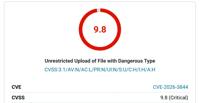
Over 400,000 WordPress Sites at Risk as “Breeze” Plugin Zero-Day Is Exploited in the Wild
A major security threat is currently sweeping through the WordPress ecosystem. Breeze, a highly popular caching plugin developed by the Cloudways team and active on over 400,000 websites, is under act ... Read more

-
Daily CyberSecurity
CVE-2026-33626: High-Severity SSRF Exploited in the Wild to Hijack AI Inference Engines
On April 21, 2026, a high-severity Server-Side Request Forgery (SSRF) vulnerability was disclosed in LMDeploy, a popular toolkit for serving vision-language and large language models (LLMs). Within a ... Read more
The following table lists the changes that have been made to the
CVE-2026-3844 vulnerability over time.
Vulnerability history details can be useful for understanding the evolution of a vulnerability, and for identifying the most recent changes that may impact the vulnerability's severity, exploitability, or other characteristics.
-
New CVE Received by [email protected]
Apr. 23, 2026
Action Type Old Value New Value Added Description The Breeze Cache plugin for WordPress is vulnerable to arbitrary file uploads due to missing file type validation in the 'fetch_gravatar_from_remote' function in all versions up to, and including, 2.4.4. This makes it possible for unauthenticated attackers to upload arbitrary files on the affected site's server which may make remote code execution possible. The vulnerability can only be exploited if "Host Files Locally - Gravatars" is enabled, which is disabled by default. Added CVSS V3.1 AV:N/AC:L/PR:N/UI:N/S:U/C:H/I:H/A:H Added CWE CWE-434 Added Reference https://plugins.trac.wordpress.org/browser/breeze/tags/2.4.1/inc/class-breeze-cache-cronjobs.php#L119 Added Reference https://plugins.trac.wordpress.org/browser/breeze/tags/2.4.1/inc/class-breeze-cache-cronjobs.php#L89 Added Reference https://plugins.trac.wordpress.org/changeset/3511463/breeze Added Reference https://www.wordfence.com/threat-intel/vulnerabilities/id/e342b1c0-6e7f-4e2c-8a52-018df12c12a0?source=cve